)
Montalcino |
)
Il Castello di Montalcino, Tuscany, Italy |
|
Montalcino |
|
|
|
Montalcino |
Il Castello di Montalcino, Tuscany, Italy |
|
The
Montalcino
Toursit Informationn office
is located very close to the main piazza and will provide visitors with,
among other things, a map that shows the location of the various
Brunello do Montalcino wineries.
Montalcino Sagra del Tordo - Festival of the Thrush
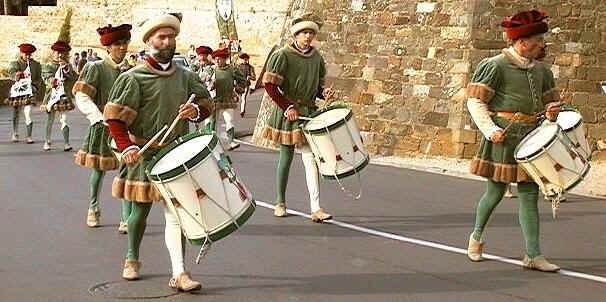
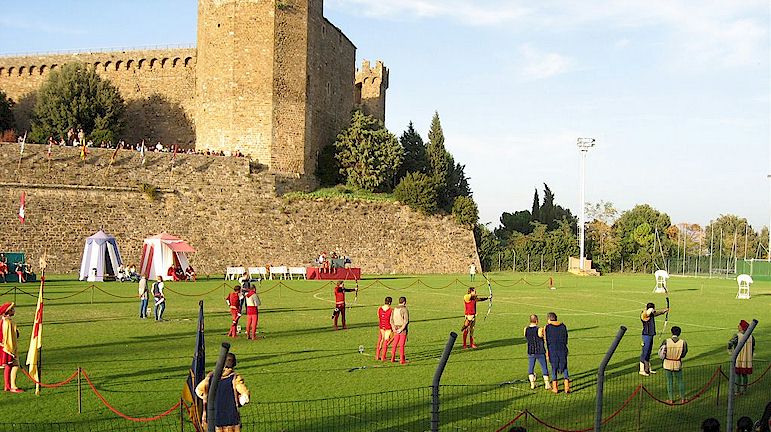
Sagra del TordoThe Sagra del Tordo (feast of the Thrush) festival takes place on the last weekend of October with drums, trumpets, costume parade etc on Saturday, followed by a day-long feast in Montalcino castle on Sunday. This feast of the thrush is open to the public and a good range of food, including roast thrushes needless to say, plus the excellent local wines are available. During the morning, there is another costume parade, and celebratory lunches are held in the four quartieri of Montalcino - Pianello, Travaglio, Ruga and Borghetto. Similar feasts are held in the evening. A limited number of visitors can book for these feasts - ask your host if you are staying in town. The main parade takes place in the afternoon, leading to the archery field, and is followed by the longbow tournament in which two archers from each quartiere compete. Tickets are required for the competition which a major annual event for the citizens of Montalcino. Unusually for Tuscany, the competition is for long bowmen although there are plenty of crossbows in evidence during the parades. Bus loads of tourists, mainly Italian, arrive on Sunday so if you plan to participate, arrive early or face a long uphill walk from where you park. Don't miss it - la Sagra del Tordo is not only about thrushes!
Travel Guide for Visitors to the Chianti Classico Wine Region of Tuscany, Italy.
Click here for a brief history of Montalcino
|
|||||||
|
|
|||||||
|
|||||||
|
Brunello di Montalcino |
|||||||
|
"Brunello di Montalcino" made its appearance in the middle of the 19 C, prepared by Clement Santi from a selection of Sangiovese Grosso grapes, the larger-berried clone of the Sangiovese variety. In Sienna in 1870, the first bottles of vintages 1863 and 1865 were exhibited as a superior ageing wine. Although the first great official vintage of Brunello di Montalcino dates back to 1888, until the mid-60s it was not well-known outside of its area of production. It began to be famous during the following ten years and became one of the most highly-rated Italian high quality wines. Over the years Brunello di Montalcino has gradually acquired greater fragrance, a more velvety flavour, a greater harmony and a delicately and intense bouquet. Today this dry wine is one of the best Italian reds. It's a strong, structured and tannic wine and it has got a very long life.
The Biondi-Santi family remained the only producer of Brunello until after World War II and the estate only released the wine on rare occasions in the greatest vintages. Between 1888 and 1945, only four vintage declarations qualified. As recently as 1960, less than a dozen estates bottled Brunello di Montalcino but today there are 220 growers and over 150 bottlers (up from 100 in the late 1980s). The Consorzio of Brunello producers, incorporating virtually all of the winemaking estates, was established in 1967, just after Italian authorities declared Brunello one of the country's first DOC classified wines in 1966. This group plays a vital role in helping establish and administer production codes (by a decree passed in 2001, it actually controls production protocols for the zone down to the most basic details) as well as leading in the marketing and promotion of Brunello abroad. Unlike the consorzio in the neighboring
Chianti Classico
region, the group in Montalcino enjoys almost unanimous participation among the region's producers and has been quite effective in helping develop Brunello's reputation as a unique "brand." De wijnen en druivensoorten uit Montalcino in Toscane, Italië |
|||||||
|
|
Montalcino |
Web hosting, web design, content management by ammonet
Montalcino © ammonet InfoTech 1998 - 2026. All rights reserved.