|
Montalcino is named after the holm oaks that used to cover the hill it stands
on and is located in the
Val
d'Orcia just over
40 km from
Sienna.
Montalcino seems to have been founded in the first decades of the 10 C by refugees from the town of Roselle
and has kept its urban structure almost since the time of its greatest expansion and brilliance, in the Middle Ages. Its stormy history together with defensive requirements have combined to give Montalcino its picturesque setting. From the avenues that skirt the walls,
there are views that could be paintings by the masters of the Siennese Trecento. Empty spaces, squares, gardens and rows of olive-trees and vines relate in a kind of counterpoint with tightly-knit streets and major buildings.
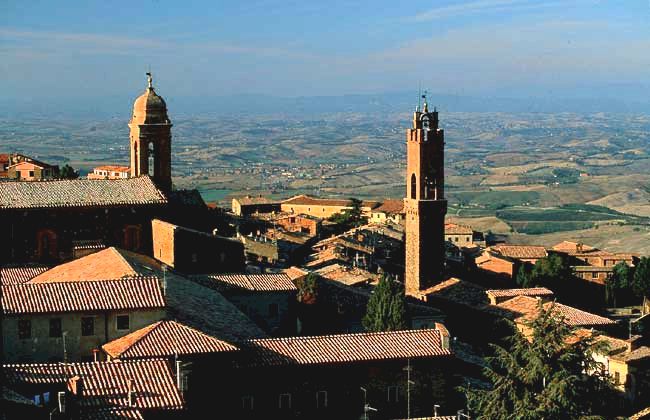
The fortress, the churches, the steep lanes and stairways and alleys and the municipal palace, with its slender tower, take us back in time to distant fascinating periods.
The discovery of neolithic artefacts near the bed of the Ombrone river, in the vicinity of Badia Ardenga and of Etruscan and Roman tombs in various places around the town, prove the existence far back in history of a dense network of rural settlements. The foundations of some of the old churches which still exist to-day, such as Santa Restituta and Sesta, date back to the barbarian invasions. Towards the end of the
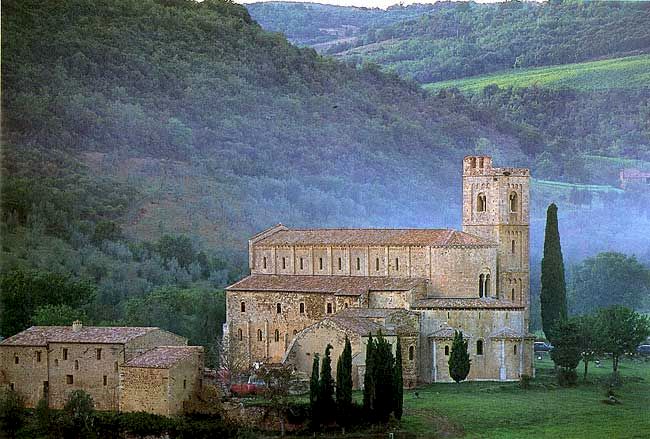
8 C the Abbey of Sant Antimo was founded, some say by Charlemagne.
The earliest settlements of Montalcino - the name first appears in a document of 814 A.D. - grew up under the feudal tutelage of the monks. They spread in the communal period, into a municipality, acquiring considerable importance, both political and military, owing to their strategic position on the old
Francigena Way. As a result they were in conflict with
Sienna from the end of the 12 C for over seventy years. During this period, sieges and wars alternated with moments of fragile peace and pacts were broken at the slightest provocation.
The battle of Montaperti (1260) gave the final victory to the Siennese, who planned to destroy Montalcino, but a few years later the situation changed once again; the
Ghibellines
were thrown out of Siena and the people of Montalcino signed a treaty of alliance with the
Guelfs
which guaranteed them substantial autonomy. In 1361, after an attempted rebellion the people of Montalcino were accorded Sienese citizenship. This was followed by a period of relative peace, during which their activities - pottery, tannery and leatherwork as well as the working of wool, wood and iron, flourished. The economic ties with Siena strengthened and, in 1404 they acquired from Siena the right to levy taxes and in the following years, a whole series of fiscal exemptions which favoured economic development. In 1462 Pius II granted Montalcino the
status of city and a bishop's seat. Then once again war. In 1526 and in 1553 the town was besieged, but was able to resist thanks to the efforts of the population.
From 1555 to 31 July 1559, the last free Italian state, the Republic of
Sienna, retired to Montalcino. The annexation to the Medici state did not provoke any great upheaval for Montalcino which maintained its importance as a productive and commercial centre. During the second half of the
17 C there were some 140 shop-owners and artisans, and the city's main activities were
tanning and shoe-making.
By the end of the following century, the reforms of Leopold and Napoleon eliminated a good number of mediaeval institutions. Economic conditions changed during the
19 C. Agriculture with a share-cropper system prevailed over other activities. At that time several of Montalcino's inhabitants took part in the events of the
Risorgimento. At the end of the century, the first mutual aid societies for workers were set up. The
First World War took a toll of 144
inhabitants. In 1920, the elections were won by the left but the following two decades were dominated by the fascist presence and by the
war. The fifties were marked by an agricultural crisis which caused heavy emigration. Halfway through the sixties,
there were the first signs of recovery with a few experiments in
industrialisation, but it was in specialised agriculture with Brunello
as the main product that Montalcino found its true vocation.
|